
 KRM Sonipat
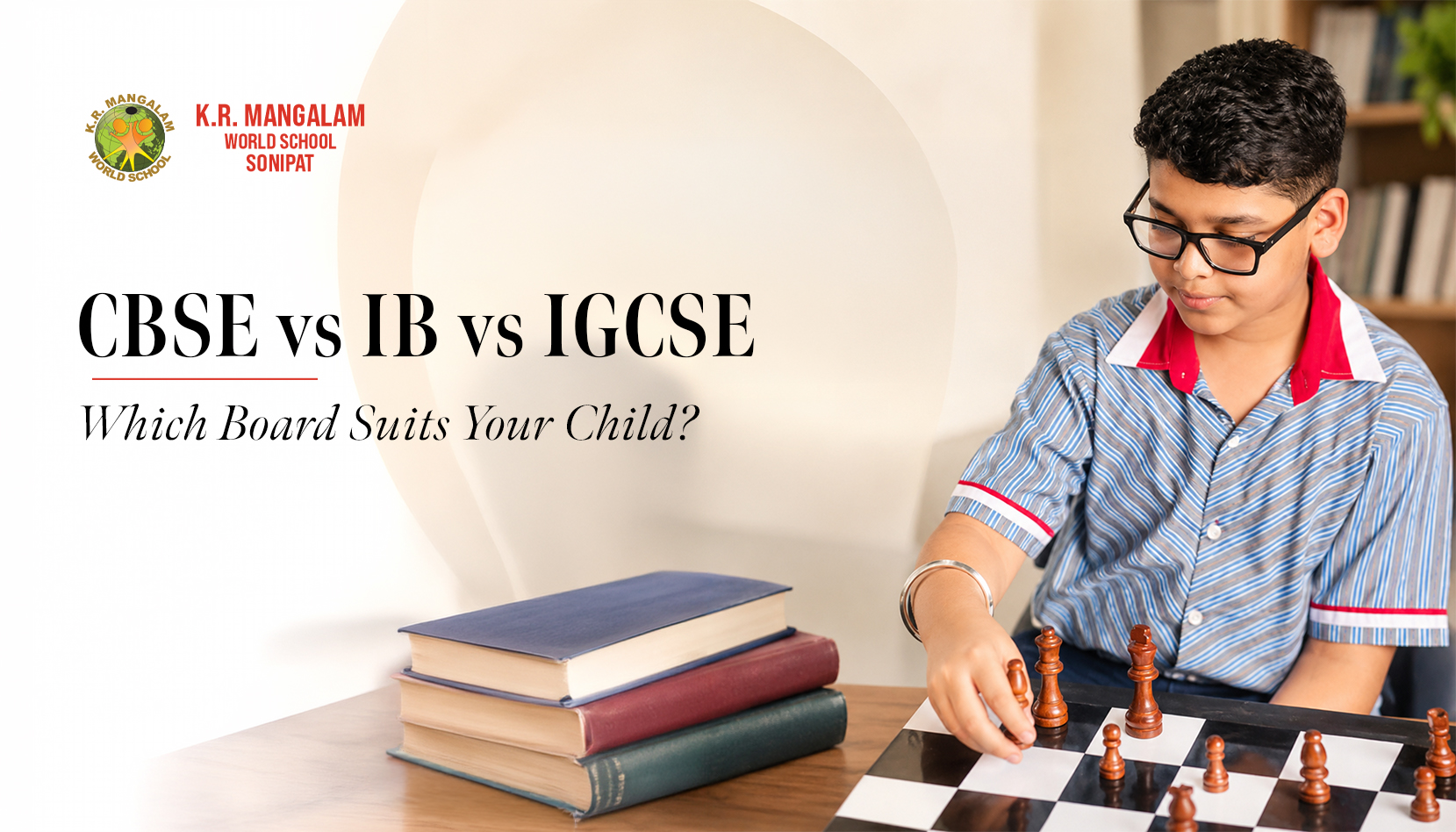
Choosing a school is one of the biggest decisions parents make. Before comparing campuses, fees or bus routes, many families first face a more basic question: which board should my child study in? CBSE, IB and IGCSE are three popular options in India, and each one shapes how a child learns, how they are tested and what their path after school may look like.
There is no single “best” board for every child. The right choice depends on your child’s learning style, your family’s plans and what you want from their education. This guide explains each board in simple terms so you can decide with confidence.
What Is a School Board and Why Does It Matter?
A school board decides what students study, how they are taught and how they are assessed. It sets the syllabus, the exam pattern and the certificate a student receives at the end of Class 10 and Class 12. Because of this, the board affects daily classroom life as well as future options such as college admissions and competitive exams.
CBSE: India’s Most Widely Followed Board
The Central Board of Secondary Education (CBSE) is a national board run by the Government of India. Its syllabus is largely based on NCERT textbooks, which are also the foundation for major entrance exams such as JEE, NEET and CUET.
CBSE is known for a clear, well-structured curriculum, especially in Science and Mathematics. In recent years, it has moved towards competency-based questions, activity-based learning and skill subjects in line with NEP 2020. Assessment reform is also changing the exam experience: it is mandatory for all students to appear in the first board exam, which is treated as the main exam, while the second board exam is mainly held for compartment and improvement. This system has applied to Class 10 since 2026. careers360
CBSE schools are found in almost every city in India, which makes it easy to continue the same board if a family moves.
IB: An Inquiry-Based International Programme
The International Baccalaureate (IB) is a global programme run by a foundation based in Geneva. It has four programmes: the Primary Years Programme (PYP), the Middle Years Programme (MYP), the Diploma Programme (DP) and the Career-related Programme (CP).
IB focuses on inquiry, research and independent thinking. Students learn through projects, presentations and open-ended questions rather than memorising answers. The Diploma Programme includes an extended essay, a course called Theory of Knowledge and community service, which builds strong writing and research skills.
IB is highly regarded by universities abroad. However, it is usually the most expensive of the three options, and fewer schools in India offer it.
IGCSE: A Flexible International Curriculum
The International General Certificate of Secondary Education (IGCSE) is offered by Cambridge and other international exam bodies. It is designed for students aged roughly 14 to 16, and many schools follow it with the Cambridge A Levels or the IB Diploma in Classes 11 and 12.
IGCSE is known for its wide choice of subjects and its focus on application of knowledge, practical work and clear written answers. Students can choose subjects that match their strengths, and some subjects are offered at two levels of difficulty.
IGCSE is recognised internationally and is a good fit for families who may move abroad. Fees are generally higher than CBSE schools but often lower than IB schools.
CBSE vs IB vs IGCSE: A Quick Comparison
| Feature | CBSE | IB | IGCSE |
|---|---|---|---|
| Governing body | Government of India | International Baccalaureate Organization | Cambridge and other international boards |
| Learning style | Structured, concept and competency based | Inquiry and research based | Application based, flexible subject choice |
| Textbooks | NCERT based | No fixed textbooks | Board-approved resources |
| Entrance exam alignment (JEE, NEET, CUET) | Strong | Needs extra preparation | Needs extra preparation |
| Availability in India | Very wide | Limited | Moderate |
| Fees | Most affordable | Usually highest | Usually higher than CBSE |
| Best suited for | Students aiming for Indian colleges and entrance exams | Students planning to study abroad, independent learners | Families wanting international exposure and subject flexibility |
How to Choose the Right Board for Your Child
Every board can lead to success. The key is matching the board to your child and your family’s goals.
1. Think About Your Child’s Future Plans
If your child is likely to prepare for JEE, NEET or other Indian entrance exams, CBSE gives a natural advantage because the syllabus closely matches these exams. If your family is seriously considering universities abroad, IB or IGCSE can offer helpful exposure, although CBSE students also get admission to foreign universities every year.
2. Understand How Your Child Learns Best
Some children do well with a clear structure, regular tests and defined chapters. Others enjoy open-ended projects and independent research. CBSE suits learners who like structure, while IB suits highly self-driven learners. IGCSE sits in between, offering flexibility with a clear exam focus.
3. Consider Stability and Relocation
If your work may involve moving between Indian cities, CBSE is the easiest board to continue because it is available almost everywhere. If you expect to move to another country, an international board may make the transition smoother.
4. Look at the Total Cost
Fees vary widely. Apart from tuition, international boards may involve higher exam fees, resources and activity costs. Plan for the full school journey, not just the first year.
5. Look Beyond the Board
A board is only one part of a child’s education. The quality of teachers, the school’s teaching approach, co-curricular activities, safety and student well-being matter just as much. A good CBSE school with experiential learning can offer many of the same skills that international boards are known for.
Why CBSE with a Modern Approach Works for Many Families
Many parents today want the strong academic base and entrance exam alignment of CBSE, along with the creativity and skills associated with international programmes. This balance is possible when a school combines the CBSE curriculum with modern teaching methods.
At K.R. Mangalam World School, Sonipat, the CBSE curriculum is taught through experiential learning, project-based learning, STEAM and a focus on multiple intelligences. Signature programmes such as Future Readiness and Personality Development help students build confidence, communication and problem-solving skills. The wider K.R. Mangalam group runs CBSE, IGCSE and IB schools, so this experience across boards shapes how learning is designed at every campus.
To see how this works in practice, you can schedule a campus tour or read our guide on How to Choose the Best CBSE School in Sonipat.
FAQs About Choosing Between CBSE, IB and IGCSE
Q1. Which board is best for JEE and NEET preparation?
CBSE is usually the most convenient choice because these exams are largely based on the NCERT syllabus that CBSE schools follow.
Q2. Are IB and IGCSE accepted by Indian universities?
Yes. Indian universities accept recognised international boards, though students may need to check equivalence rules and subject requirements for specific courses.
Q3. Can my child switch boards later?
Yes, many students switch, often after Class 10. The move is easier at natural transition points, and students may need some time to adjust to a new style of teaching and assessment.
Q4. Is CBSE good enough for studying abroad?
Yes. Many CBSE students get admission to universities abroad every year. Strong grades, English skills, standardised test scores and a good profile of activities matter more than the board alone.
Q5. Which board is the least stressful?
No board is stress-free. Stress depends more on the school’s environment, teaching methods and support at home than on the board itself.
Conclusion
CBSE, IB and IGCSE are all respected boards, and each can prepare students for a successful future. CBSE offers a strong academic foundation, affordability and close alignment with Indian entrance exams. IB builds independent thinkers ready for global universities, while IGCSE offers flexibility and international exposure. The best choice is the one that fits your child’s learning style, your family’s plans and your budget. Most importantly, choose a school that cares about how your child learns, not just what they study.