
 KRM Sonipat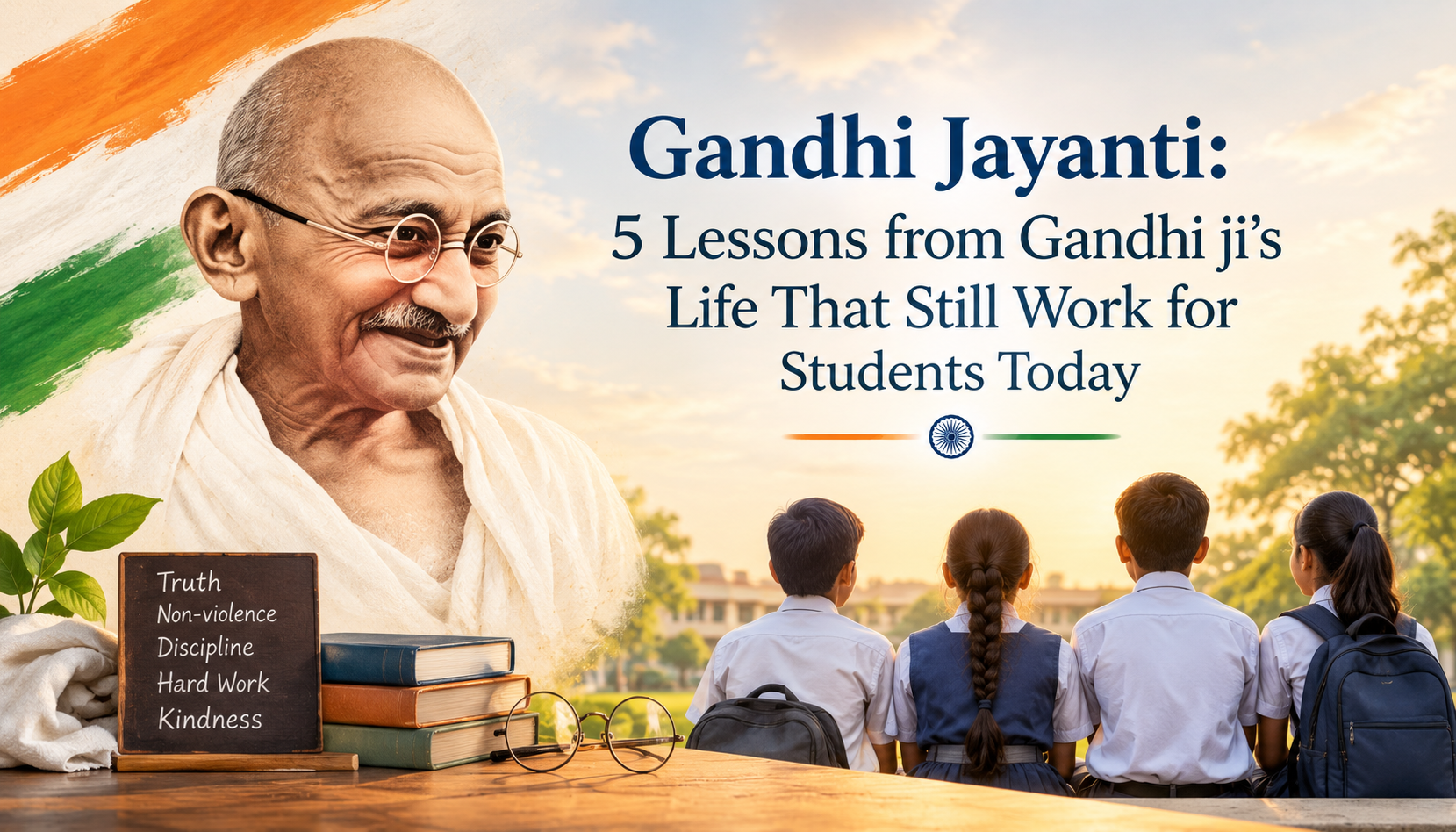
Every year on 2nd October, schools across India pause to remember a man who changed the country without ever holding a weapon. Gandhi Jayanti 2026 marks Mahatma Gandhi’s birth anniversary, and it’s more than a school holiday with a prayer assembly. It’s a chance to look at how one person’s choices, made quietly and consistently, still shape the way we think about honesty, discipline and courage today.
Why We Celebrate Gandhi Jayanti
Why we celebrate Gandhi Jayanti comes down to what Gandhi stood for rather than just what he achieved. He led India to independence through non-violence and truth, at a time when most freedom movements around the world relied on force. Schools mark the day with speeches, skits and reflection because his life offers something textbooks often miss: proof that values, not just victories, can change history.
For students, that’s the real reason this day matters. It isn’t only about remembering a leader. It’s about noticing how ordinary habits, patience, honesty, simplicity, can add up to something extraordinary.
5 Lessons from Gandhi’s Life for Students
Here are five Mahatma Gandhi life lessons that still hold up in a classroom, a hostel room or a group project.
- Truth is a habit, not a one-time decision.
Gandhi called his autobiography “The Story of My Experiments with Truth,” and that word, experiments, matters. He didn’t claim to be perfect. He kept testing himself, correcting his mistakes, and choosing honesty even when a small lie would have been easier. For students, that means admitting a wrong answer, rather than hiding it, admitting when you’ve not studied, rather than pretending you have. Truthfulness with yourself is what makes real improvement possible. - Discipline beats motivation.
Gandhi had a strict daily routine, early mornings, set hours for reading, writing and reflection and habits, consistent for decades. He didn’t wait for inspiration to do the job. This is one of the most practical Gandhian values for students preparing for exams or juggling multiple subjects. A regular study schedule you stick to daily will always beat sporadic moments of last-minute effort. - Simplicity sharpens focus.
Gandhi owned almost nothing; a few clothes, some basic tools, and little else. He believed that fewer distractions meant a clearer mind. Students today deal with a different kind of clutter, notifications, social media, constant comparison. Gandhi’s approach is a simple one: cut out what doesn’t matter, and focus on what does. - Courage doesn’t have to be loud.
Gandhi led some of the largest movements in history without raising his voice or resorting to violence. His courage was the silent kind, standing by a principle when it was unpopular, when it was dangerous. For a student, it could mean standing up to bullies, owning up to a mistake in front of the class or being true to an honest answer despite peer pressure. Courage is often calm, not dramatic. - Small actions build big change.
The Salt March covered nearly 240 miles, one step at a time. Gandhi never treated any single action as too small to matter. This is perhaps the most useful lesson for a student overwhelmed by a long syllabus or a big goal: break it down, and trust that consistent small steps add up.
Teachings of Mahatma Gandhi That Still Apply in the Classroom
The teachings of Mahatma Gandhi were never meant to stay in history books. They show up in a classroom every time a student chooses honesty over a shortcut, sticks to a study schedule instead of cramming, or stands up for a classmate quietly rather than staying silent. Gandhi Jayanti is a reminder that character is built the same way habits are: slowly, and through repetition.
Conclusion
Gandhi Jayanti gives students a chance to look past the dates and freedom struggle facts and ask a simpler question: what would it look like to live by these values today? Truthfulness, discipline, simplicity, quiet courage and patience with small steps are not lessons that belong only to history. They are habits any student can start practising this year, in the classroom and outside it.
At K.R. Mangalam World School, Kundli, we believe education is about building character alongside academics. To know more about how we bring values like these into everyday learning, visit the official website.