
 KRM Sonipat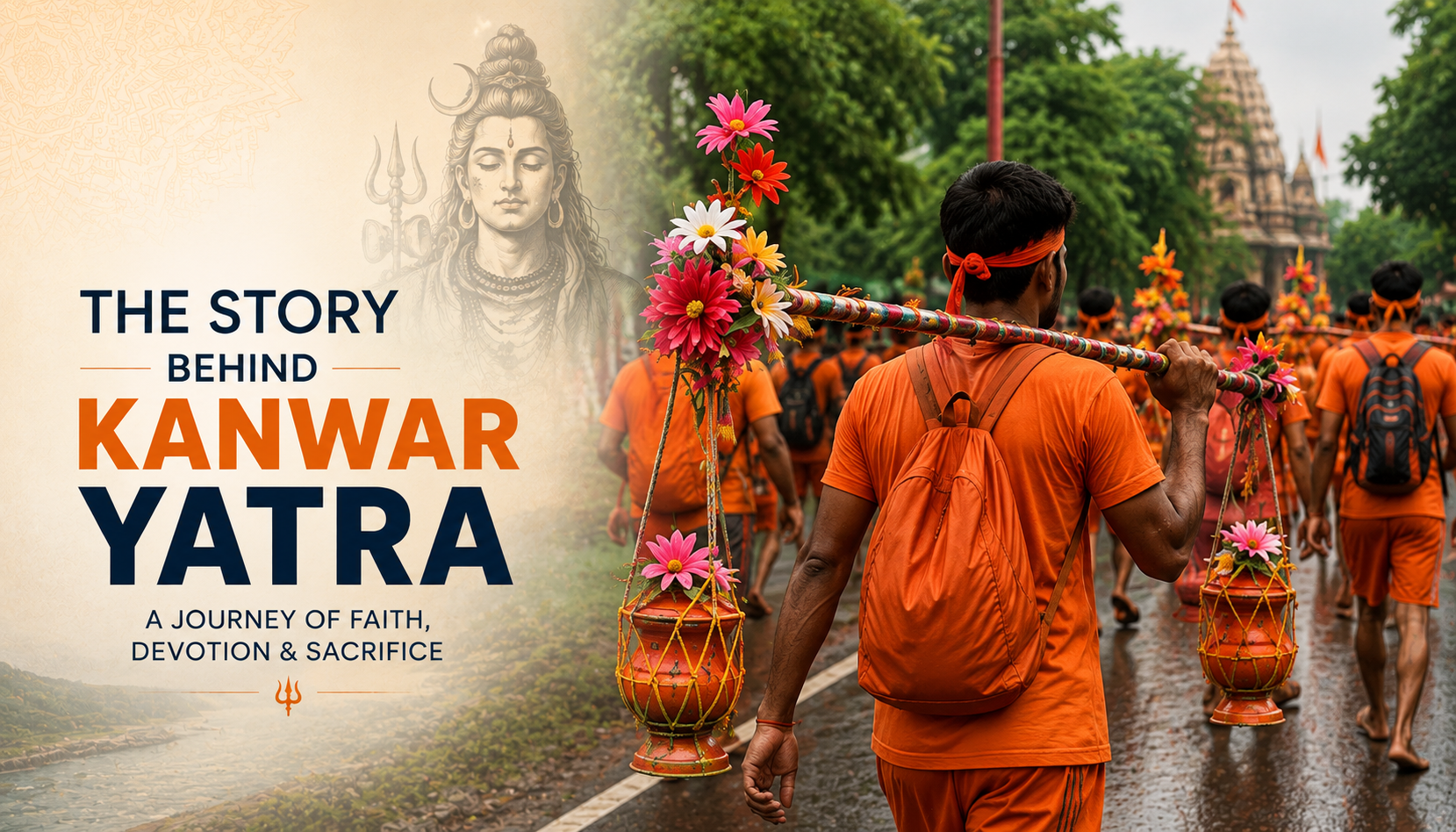
Every monsoon, roads across parts of northern and eastern India take on a different tune. The sight is remarkable, but the meaning lies less in spectacle than in the discipline of carrying something sacred across an ordinary landscape. People walk for kilometres carrying decorated bamboo sticks on their shoulders; chanting “Bol Bam” and “Har Har Mahadev,” while wearing saffron coloured clothes. The journey, often referred to as the Kanwar Yatra, is a display of faith, endurance and collective devotion that can be seen from across India once a year.
What is Kanwar Yatra? The Story Behind Kanwar Yatra
At its heart, the pilgrimage is easy. The devotees are called Kanwariyas & bum, who travel to sacred stretches of the Ganga, including Haridwar, Gangotri, Gaumukh, and Sultanganj. They collect Gangajal in pots, and carry it back to Shiva temples for jalabhishek (the ritual bathing of the Shiva linga). The water is traditionally carried in a kanwar (a pole, often made of bamboo), with containers attached at both ends.
The journey takes place during Shravan, which is a Hindu holy month closely associated with Lord Shiva. Many devotees walk barefoot and observe personal fasts and rituals during the journey. The Sultanganj-to-Deoghar route, for example, is roughly 105 kilometres.
So, what is Kanwar Yatra beyond a religious belief? For devotees, it is a process of offering. The physical effort matters because the journey itself is the part of the prayer.
The Kanwar Yatra Story and Its Link to Shiva
The most famous Kanwar Yatra story is attached with Samudra Manthan, the churning of the cosmic ocean in Hindu tradition. The most popular Kanwar Yatra narrative is related to the churning of the cosmic ocean called Samudra Manthan in Hindu mythology. The nectar of immortality appeared before a harmful poison, known as halahala, which is said to have killed everyone who consumed it. The Government of India’s Utsav portal also connects the pilgrimage with the Samudra Manthan narrative.
Different regions preserve other traditions too. Some accounts associate the first such offering with Parashurama, while others mention Ravana or Lord Rama carrying holy water for Shiva. Rather than one fixed historical origin, the pilgrimage carries layers of mythology, local memory, and devotional practice.
That is what makes the Kanwar Yatra story so compelling. Its power does not depend on a single version. Every telling returns to the same idea of bhakti expressed through effort and offering.
What is the Significance of Kanwar Yatra Today?
Beyond mythology, the Kanwar Yatra significance lies in what it represents for the people who take part in it. For many, the walk is a personal vow, taken after a prayer was answered, or a hardship overcome. For others, it is simply a yearly act of gratitude and discipline.
A few things stand out about how it functions today:
| Aspect | What It Looks Like |
| Scale | Crores of pilgrims participate across UP, Uttarakhand, Delhi, Haryana, and Bihar each year |
| Discipline | Many observe fasting, avoid alcohol and non-vegetarian food, and walk barefoot |
| Community | Local volunteers set up free food and rest camps along every major route |
| Economy | Local vendors, transport operators, and small businesses see a seasonal boost |
The Kanwar pilgrimage has also been a matter of discussion about how the Indian states handle movement of millions of pilgrims, traffic and security during the course of ten days. But under the logistics it is still what it’s always been: physical devotion, the act of traveling itself an offering.
A Pilgrimage That Moves Through Everyday India
The Kanwar pilgrimage is unique as it is not restricted to within the temples. It covers highways, villages, market towns, riverbanks, and city streets. Ordinary roads temporarily become devotional spaces, filled with chants, music, flags, rest camps, and streams of pilgrims.
There are different ways of undertaking the journey. Some devotees walk steadily and rest along the route, while participants in Dak Kanwar travel much faster and attempt to complete the return journey within a tightly observed period.
Why Does Tradition Matter?
The enduring appeal of the Kanwar pilgrimage is difficult to understand through distance or scale alone. Its strength comes from participation. The ritual is not just to look at, it’s to carry, to walk, to wait, to chant, to serve, to endure, to offer.
That is why the Kanwar Yatra continues to hold meaning across generations. It transforms movement into worship and effort into remembrance. The final offering of Gangajal may take only a few moments, but those moments contain every step that came before them.
In that sense, the pilgrimage lives up to the idea of devotion in motion. Faith is not only spoken or believed here. It is carried on the shoulder, measured in footsteps, and offered, drop by drop, at the feet of Shiva.